How a 12-year-old's walk home from school led to Iron Max — a solar ironing cart cutting charcoal use, deforestation, and pollution across India.
 Rashmeet Kaur Chawla
Every month India gets a new plan to go green. A new company promises to help. A new hashtag appears on social media. People even build solar parks and plant lots of trees. Important meetings about climate change. They make big reports. If you walk around a small town in India you will still see people using charcoal to iron clothes. You will see smoke going up in the air and trees being cut down somewhere.
This is the difference between the India we see in pictures and the real India where people live and breathe. Vinisha Umashankar, a teenager from Tiruvannamalai, Tamil Nadu is one of the people who has tried to close this gap. She has actually done something to make a difference. India needs people, like Vinisha Umashankar, to make the country greener.
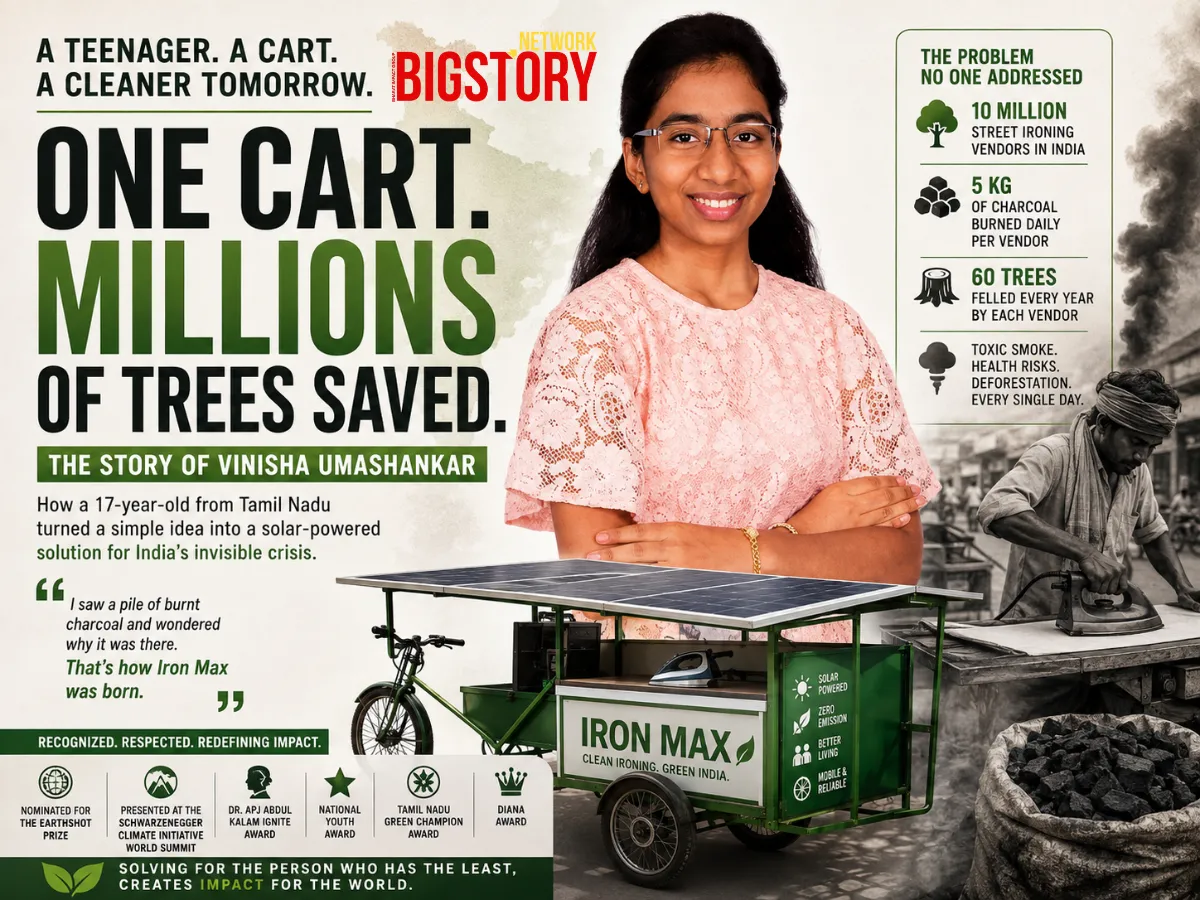
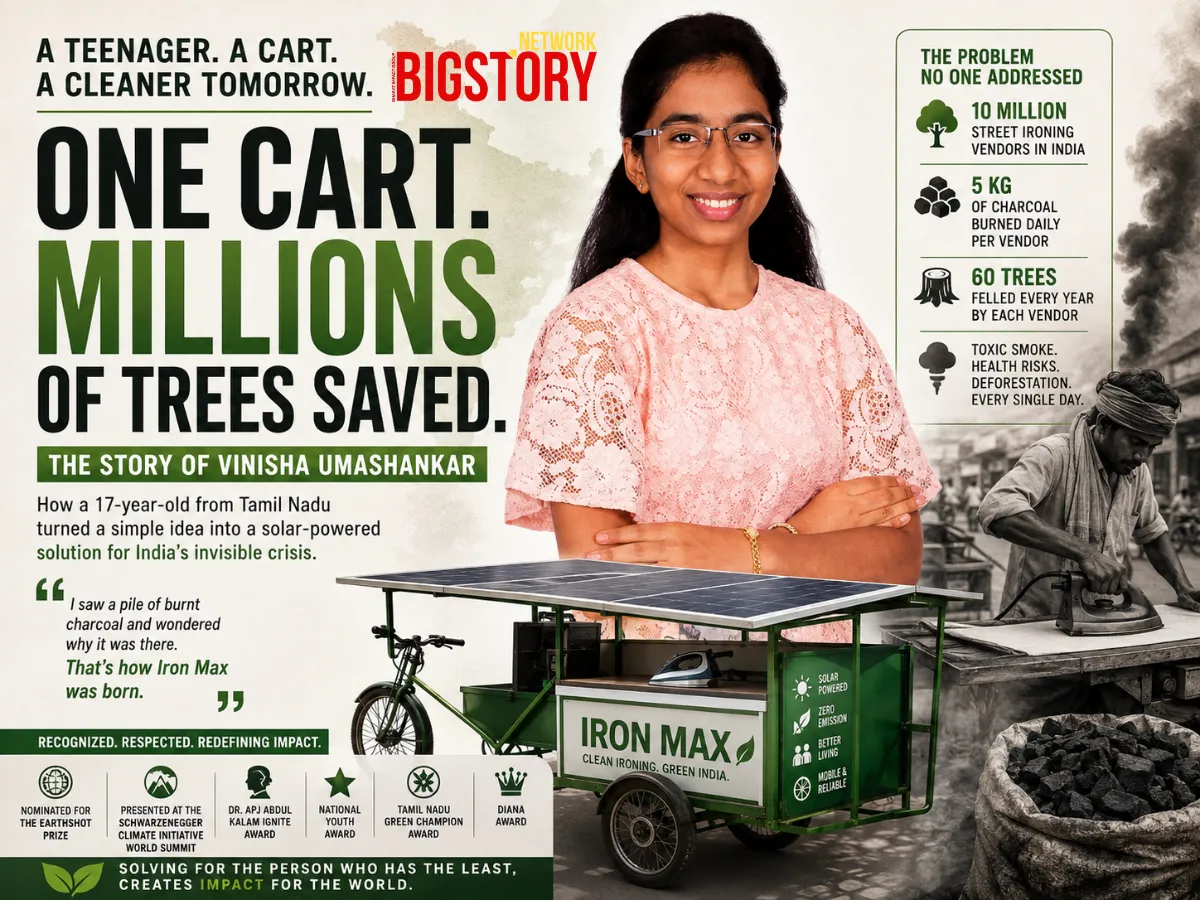
The problem, once you hear it, sounds almost too simple to be true. India has close to 10 million street ironing vendors. Each burns around 5 kilograms of charcoal a day, which adds up to roughly 60 trees felled per vendor every year. Multiply that across the country, and an entire invisible supply chain of deforestation runs quietly through neighborhoods no environmental audit ever visits. The workers running these carts inhale that smoke daily, absorbing the health cost of a livelihood no one had bothered to redesign.
This is the paradox at the center of India's climate story: 22 of the world's 30 most polluted cities are Indian, yet the fixes proposed for that pollution rarely reach the informal economy where a large share of the damage actually originates. Big institutions debated emissions targets while a very ordinary, very visible source of harm sat unaddressed on nearly every street corner in the country.
Vinisha's answer was not a policy paper, it was actually a cart. The Iron Max is a cart that runs on sunlight. It is a powered mobile ironing cart with panels on the roof that can store power for ironing for about six hours using only five hours of sunlight. The cart also has a battery and can be connected to the power grid or a generator so it can be used on cloudy days. The cart is also useful for vendors because it has USB ports that people can use to charge their phones and the vendors can earn some money from this. The cart can move around because it has a motor so vendors do not have to stay in one place they can go to peoples homes to provide their service.
What is really great about this is not just how it was made. Where the idea for it came from. The idea for the Iron Max did not come from a laboratory or a big research project; it came from a day when Vinisha was walking home from school. On that day she saw a pile of burnt charcoal. She wondered why it was there and that is how she got the idea for the Iron Max cart.
Most new ideas to help the environment in India are made by companies or the government and given to the people. Vinisha did it the other way around. She made something that would help the street vendors first. She did not make it to impress investors or win awards.
She wanted to know how a person who earns money every day can keep working without hurting the environment.
This way of thinking is what makes Iron Max different from projects that are supposed to be good, for the environment. Those projects often stop working when they have to deal with life problems. Iron Max does not need conditions to work. It does not ask the vendors to stop selling things. It just asks them to use a kind of fuel and a different way of selling. It is a way to help the environment that was made for people who cannot afford to lose a day's pay.
These are the people that most projects to help the environment forget about. Vinisha's approach and Iron Max are really helping the people who need it most, the street vendors and daily-wage workers, by giving them a way to keep earning money without hurting the environment.
Vinisha's work is doing something good. It is taking on the problems of deforestation, pollution and poverty all at once. When a cart owner switches from charcoal to power it means that trees get to stay standing. The vendor does not have to breathe in smoke anymore.The air in Indian cities becomes a little bit cleaner.
The National Innovation Foundation India liked Vinisha's idea so much that they built a working prototype from her design in 2019. They took a sketch from a school girl and turned it into something that really works.
People started to notice Vinisha's work. She got a lot of recognition. She was nominated for the Prince Williams Earthshot Prize, which's a really big deal. She was the person to ever be nominated for this prize.
Vinisha's recognition didn't stop there. She went on to present at the Schwarzenegger Climate Initiative's World Summit, and her work has since been honoured with the Dr. APJ Abdul Kalam IGNITE Award, the National Youth Award, the Tamil Nadu Green Champion Award, and the Diana Award.
These accolades matter, but not for the reasons trophies usually do. What they really demonstrate is that climate solutions born from lived observation — not boardrooms or research labs — can hold their own against innovations backed by institutional resources. Vinisha's journey is proof that grassroots ideas, taken seriously and given the right support, can compete with, and sometimes outpace, solutions engineered by corporations with far greater means.
India is really focusing on energy and getting people who work on their own to be part of the solution and stopping the use of biomass burning. This is what Vinisha has been working on for years. As India tries to reach its goal of not hurting the environment, the real challenge is not about building solar parks in the desert but about changing small things like the ironing cart to make the future cleaner.
Vinisha's idea is a plan: find a big problem that people are not paying attention to and make a new design that helps the person who needs it to survive and show that it works before asking people to agree.
A cleaner India will not be made by doing a few big projects. It will be made by making a lot of changes, like this one. Each one may seem small but together they will make a big difference.
The story of Green India is not just about successes that make the news. It is about the people who are making a difference and creating things that others can do too. Vinisha's story is an example of this. She is not a young person who talks about ideas, she is an inventor who created something that works and is recognized all around the world. She did it all before she was eighteen years old.
Her story has everything that the story of Green India needs: a problem that is based on facts that most people do not know about a solution that is practical and helps people and a challenge to everyone. Whether you are a big company, a person starting your own business or a student.
To stop waiting for someone to tell you what to do and just fix the problem. Vinisha's journey shows that if you "solve for the person who has the least" you will create something that the whole world will pay attention to. For a publication that is writing about India's path to a greener future this is not just a nice story. It is an idea that guides us. Green India is about people like Vinisha who are making a difference and Green India needs stories, like hers.
 Exclusive Content


Sign up for the Daily newsletter to get your biggest stories, handpicked for you each day.

 Trending Now! in last 24hrs